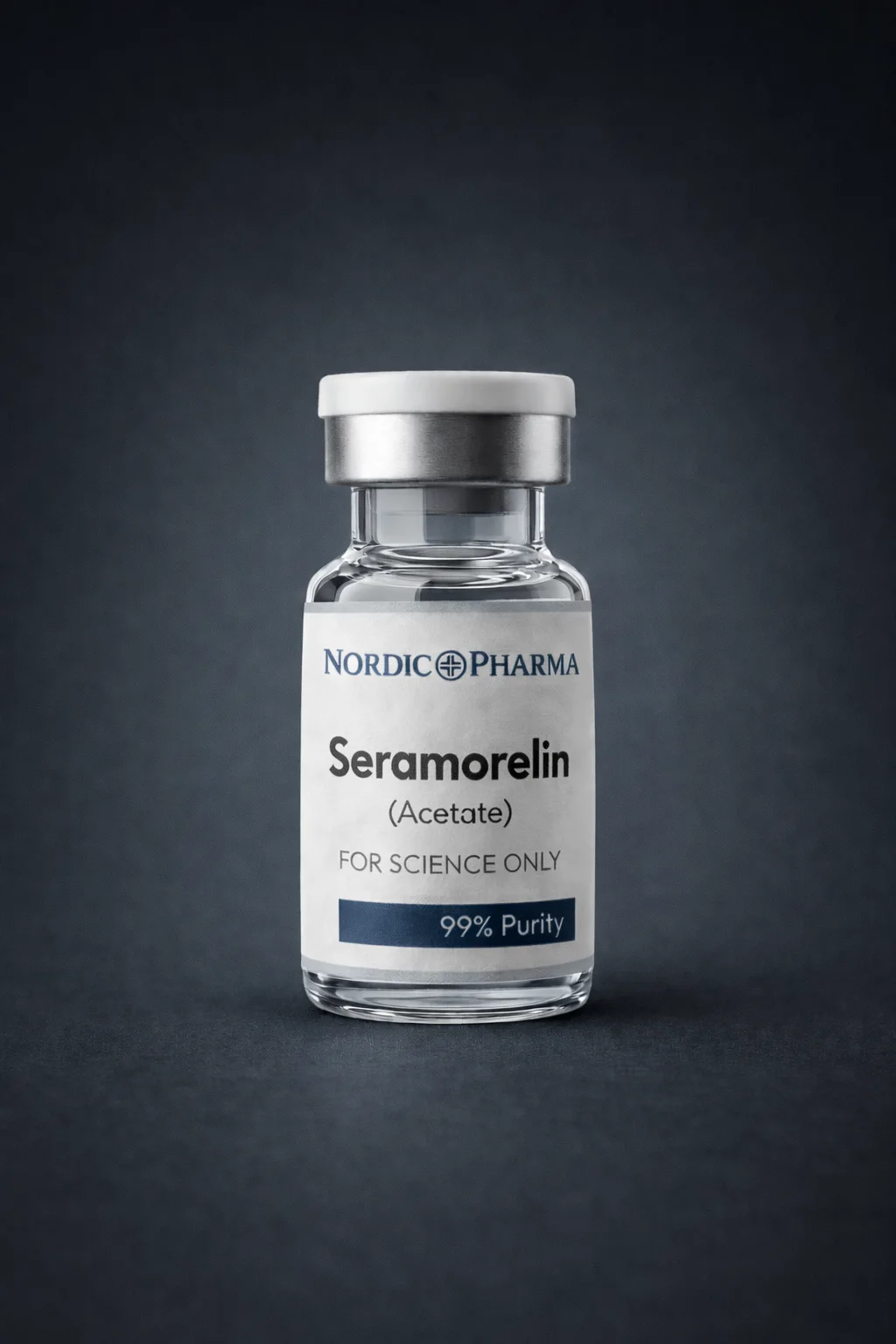
Seramorelin Acetate | 10 vials
Sermorelin acetate is a synthetic peptide analog of growth hormone-releasing hormone (GHRH) that corresponds to the amino-terminal segment (1-29) of the naturally occurring 44-amino acid human GHRH . It represents the shortest fully functional fragment of GHRH, retaining full biological activity while offering enhanced stability compared to the endogenous hormone . Discovery and Development Sermorelin was developed by EMD Serono and received FDA approval in 1990 under the brand name Geref® for two primary indications: Diagnostic agent: To assess pituitary function and diagnose growth hormone deficiency Therapeutic agent: For treating growth hormone deficiency in children The FDA approval was discontinued in 2008 for commercial reasons, with the FDA explicitly determining that it was not withdrawn due to safety or efficacy concerns . This has allowed sermorelin to remain available as a compounded medication for off-label use in anti-aging and wellness medicine . Physicochemical Properties Property Specification CAS Number 114466-38-5 UNII 00IBG87IQW Molecular Formula C₁₄₉H₂₄₆N₄₄O₄₂S (free base) Molecular Weight ~3,358 Da (free base) IUPAC Name Acetic acid; (3S)-... (complex peptide IUPAC name) Synonyms Geref, Gerel, GHRH (1-29), Growth hormone-releasing factor (1-29), Sermorelin acetate [USAN] Amino Acid Sequence H-Tyr-Ala-Asp-Ala-Ile-Phe-Thr-Asn-Ser-Tyr-Arg-Lys-Val-Leu-Gly-Gln-Leu-Ser-Ala-Arg-Lys-Leu-Leu-Gln-Asp-Ile-Met-Ser-Arg-NH₂ · CH₃CO₂H Sequence Shortening YADAIFTNSYRKVLGQLSARKLLQDIMSR EINECS Number 466-138-5 MDL Number MFCD08277636 Purity (Research Grade) ≥98% Appearance Lyophilized powder Storage Temperature -20°C for long-term; 0-4°C for short-term Solubility Soluble in DMSO; limited water solubility LogP 5.07 Hydrogen Bond Donor Count 53 Hydrogen Bond Acceptor Count 51 Rotatable Bond Count 118 Mechanism of Action GHRH Receptor Activation: Sermorelin functions as a potent agonist at GHRH receptors located on somatotroph cells in the anterior pituitary gland . By binding to these receptors, it stimulates the synthesis and pulsatile release of endogenous growth hormone (GH) . Key Pharmacological Characteristics: Parameter Finding Source Bioavailability (SC) ~6% Peak Concentration (Tmax) 5-20 minutes (SC administration) Volume of Distribution 23.7-25.8 L (IV) Half-life 11-12 minutes (IV or SC) Clearance 2.4-2.8 L/min pH (reconstituted) 5.0-5.5 Physiological Cascade: Upon GHRH receptor activation, the following cascade occurs: GH secretion: Pituitary somatotroph cells release GH into circulation in a pulsatile manner, closely mirroring endogenous nocturnal GH surges IGF-1 production: GH acts on hepatocytes and peripheral tissues to stimulate insulin-like growth factor 1 (IGF-1) production, mediating many of the anabolic effects of GH Feedback regulation: IGF-1 and somatostatin provide negative feedback, keeping GH levels within physiologic norms and making overdose "difficult if not impossible to achieve" Key Distinction from Recombinant hGH: Unlike recombinant human growth hormone (rhGH), which can raise GH to supraphysiological levels and suppress endogenous production, sermorelin: Stimulates the body's own GH production Preserves natural feedback loops (IGF-1, somatostatin) Causes minimal pituitary suppression or tachyphylaxis Does not perturb adjacent hormonal feedback loops Is virtually incapable of causing overdose Clinical Applications and Research Findings Pediatric Growth Hormone Deficiency: Sermorelin was originally approved for diagnosing and treating growth hormone deficiency in children. In clinical trials involving 350 patients, the most common treatment-related adverse event was local injection reaction (occurring in about 1 in 6 patients) . Three patients discontinued therapy due to injection reactions . Adult Growth Hormone Deficiency and Age-Related Decline: Sermorelin is now widely used in adults with growth hormone deficiency (AGHD) and age-related GH decline . A 2006 article by Richard Walker described sermorelin as an "effective and attractive treatment of adult-onset GH insufficiency" with clinical advantages over exogenous hGH, including not being associated with the pro-cancer and pro-diabetes side effects linked to long-term hGH therapy . Body Composition and Muscle Preservation: Study Population Finding Source 1997 RCT Elderly men and women (16 weeks nightly SC) Significant increase in skin thickness; male subjects gained average 1.26 kg lean body mass 2020 Review Hypogonadal males Significantly improves body composition; ameliorates fat gain and muscular atrophy Current practice GLP-1 users Counteracts muscle loss during weight management by restoring physiologic GH pulses Anti-Aging Research: A 1992 study found that short-term subcutaneous sermorelin injections enabled healthy male test subjects (aged 60-78) to reverse age-related decreases in GH and IGF-1 levels . The 1997 study also noted notable increases in libido and wellbeing in elderly subjects . Cardiovascular Research: A 2015 study in post-heart attack animal models demonstrated that sermorelin offered: Reduced remodeling following myocardial infarction Increased growth of blood vessels in damaged tissue Reduction in cell death in cardiomyocytes Cognitive and Sleep Effects: Sermorelin use is hypothesized to improve deep rapid eye movement (REM) sleep . A 2013 study showed GHRH effects on brain GABA levels in mild cognitive impairment . Safety Profile Common Adverse Events (from clinical trials) : Adverse Event Frequency Injection site reactions ~1 in 6 patients (pain, swelling, redness) Facial flushing Common (especially with IV administration) Headache <1% Nausea <1% Vomiting <1% Dysgeusia (strange taste) <1% Dizziness <1% Pallor <1% Immunogenicity: A large proportion of patients develop anti-GRF antibodies at least once during treatment with sermorelin . The significance of these antibodies is not clear, and often a positive test at one growth assessment will become negative by the next assessment. The presence of antibodies does not appear to affect growth or be related to a specific adverse reaction profile . Serious Adverse Events: No generalized allergic reactions to sermorelin have been reported . No cases of clinically apparent acute liver injury attributable to sermorelin have been documented. Limitations and Contraindications : Do not use in cancer or tumor patients (theoretical risk; GH/IGF-1 may promote cell proliferation) Not recommended in patients with intracranial lesions Hypothyroidism can jeopardize response to sermorelin; thyroid hormone determinations should be performed before and during therapy Pregnancy Category C —use only if potential benefit justifies potential risk to fetus Nursing women —caution should be exercised Known hypersensitivity to sermorelin or excipients Drug Interactions : Concomitant glucocorticoid therapy may inhibit the response to sermorelin No significant interactions reported with other common medications Pharmacokinetics Absorption: Following subcutaneous administration of 2 mg sermorelin to 12 normal volunteers, peak concentrations were reached in 5-20 minutes . The mean absolute bioavailability after SC administration is about 6% . Distribution: After intravenous administration of 0.25-1.0 mg, the mean volume of distribution ranged between 23.7-25.8 liters . Metabolism: No formal metabolism studies have been performed in humans; as a polypeptide, it is likely degraded by proteolytic enzymes . Elimination: Sermorelin is rapidly cleared from the circulation, with clearance values in adults ranging between 2.4-2.8 L/min . The half-life is short, 11-12 minutes after either intravenous or subcutaneous administration . Special Populations : Gender/Age: Clearance similar in men and women; no age data available Renal/Hepatic Insufficiency: No data available Regulatory Status Authority Status Date FDA (USA) Approved (original) December 28, 1990 FDA Marketing discontinued 2008 FDA Determination Not discontinued for safety/effectiveness reasons 2013 Compounded Use Available by prescription Current WADA Banned (growth hormone secretagogues) Current Research Use Available for laboratory research Current Orphan Drug Designation: In 1990, sermorelin acetate received orphan drug designation as an "adjunct to gonadotropin therapy in the induction of ovulation in women with anovulatory or oligo-ovulatory infertility who fail to ovulate in response to adequate treatment with clomiphene citrate alone and gonadotropin therapy alone" . This designation was later withdrawn or revoked. Dosing and Administration (Clinical Context) Reconstitution : Reconstitute with Sodium Chloride Injection, USP Inject diluent against glass vial wall Swirl gently—do not shake Do not administer if particles visible or solution cloudy Common Protocols : Route Dosage Frequency Subcutaneous injection 0.15-0.3 mL of 1 mg/mL solution Nightly, 5 out of 7 days per week Mini troches 600 mcg Nightly buccal, 5 out of 7 days Nasal spray 1000 mcg/mL 1 spray up to 3 times daily Timing Considerations : Administer at night before bed, at least 2 hours after eating Alternatively, first thing in morning when endogenous GH levels are typically at peak Empty stomach recommended for optimal absorption Expected Timeline of Clinical Response : Time Period Potential Effects Weeks 1-2 Improved sleep depth, morning energy Weeks 3-6 Enhanced focus, faster recovery, increased libido, improved skin tone Months 2-3 Visible body composition improvement, greater endurance Months 6+ Sustained lean mass, improved bone density, overall vitality Comparison with Related Peptides Peptide Mechanism Key Features FDA Status Sermorelin GHRH(1-29) agonist Short half-life (11-12 min); physiologic GH pulses Approved (discontinued); compounded use Tesamorelin Full-length GHRH analog Longer half-life; HIV lipodystrophy indication FDA approved (Egrifta®) CJC-1295 (with DAC) GHRH analog with albumin binding Half-life ~8 days; sustained release Research only CJC-1295 (no DAC) GHRH(1-29) analog Similar to sermorelin; research grade Research only Ipamorelin Ghrelin receptor agonist GH secretagogue; minimal ACTH/cortisol Research only rhGH Recombinant human GH Direct hormone replacement FDA approved Important Notice FOR RESEARCH USE ONLY. NOT FOR HUMAN USE, THERAPEUTIC, OR DIAGNOSTIC APPLICATIONS outside approved clinical settings.
SKU: WOO-543
Sermorelin acetate is a synthetic peptide analog of growth hormone-releasing hormone (GHRH) that corresponds to the amino-terminal segment (1-29) of the naturally occurring 44-amino acid human GHRH . It represents the shortest fully functional fragment of GHRH, retaining full biological activity while offering enhanced stability compared to the endogenous hormone . Discovery and Development Sermorelin was developed by EMD Serono and received FDA approval in 1990 under the brand name Geref® for two primary indications: Diagnostic agent: To assess pituitary function and diagnose growth hormone deficiency Therapeutic agent: For treating growth hormone deficiency in children The FDA approval was discontinued in 2008 for commercial reasons, with the FDA explicitly determining that it was not withdrawn due to safety or efficacy concerns . This has allowed sermorelin to remain available as a compounded medication for off-label use in anti-aging and wellness medicine . Physicochemical Properties Property Specification CAS Number 114466-38-5 UNII 00IBG87IQW Molecular Formula C₁₄₉H₂₄₆N₄₄O₄₂S (free base) Molecular Weight ~3,358 Da (free base) IUPAC Name Acetic acid; (3S)-... (complex peptide IUPAC name) Synonyms Geref, Gerel, GHRH (1-29), Growth hormone-releasing factor (1-29), Sermorelin acetate [USAN] Amino Acid Sequence H-Tyr-Ala-Asp-Ala-Ile-Phe-Thr-Asn-Ser-Tyr-Arg-Lys-Val-Leu-Gly-Gln-Leu-Ser-Ala-Arg-Lys-Leu-Leu-Gln-Asp-Ile-Met-Ser-Arg-NH₂ · CH₃CO₂H Sequence Shortening YADAIFTNSYRKVLGQLSARKLLQDIMSR EINECS Number 466-138-5 MDL Number MFCD08277636 Purity (Research Grade) ≥98% Appearance Lyophilized powder Storage Temperature -20°C for long-term; 0-4°C for short-term Solubility Soluble in DMSO; limited water solubility LogP 5.07 Hydrogen Bond Donor Count 53 Hydrogen Bond Acceptor Count 51 Rotatable Bond Count 118 Mechanism of Action GHRH Receptor Activation: Sermorelin functions as a potent agonist at GHRH receptors located on somatotroph cells in the anterior pituitary gland . By binding to these receptors, it stimulates the synthesis and pulsatile release of endogenous growth hormone (GH) . Key Pharmacological Characteristics: Parameter Finding Source Bioavailability (SC) ~6% Peak Concentration (Tmax) 5-20 minutes (SC administration) Volume of Distribution 23.7-25.8 L (IV) Half-life 11-12 minutes (IV or SC) Clearance 2.4-2.8 L/min pH (reconstituted) 5.0-5.5 Physiological Cascade: Upon GHRH receptor activation, the following cascade occurs: GH secretion: Pituitary somatotroph cells release GH into circulation in a pulsatile manner, closely mirroring endogenous nocturnal GH surges IGF-1 production: GH acts on hepatocytes and peripheral tissues to stimulate insulin-like growth factor 1 (IGF-1) production, mediating many of the anabolic effects of GH Feedback regulation: IGF-1 and somatostatin provide negative feedback, keeping GH levels within physiologic norms and making overdose "difficult if not impossible to achieve" Key Distinction from Recombinant hGH: Unlike recombinant human growth hormone (rhGH), which can raise GH to supraphysiological levels and suppress endogenous production, sermorelin: Stimulates the body's own GH production Preserves natural feedback loops (IGF-1, somatostatin) Causes minimal pituitary suppression or tachyphylaxis Does not perturb adjacent hormonal feedback loops Is virtually incapable of causing overdose Clinical Applications and Research Findings Pediatric Growth Hormone Deficiency: Sermorelin was originally approved for diagnosing and treating growth hormone deficiency in children. In clinical trials involving 350 patients, the most common treatment-related adverse event was local injection reaction (occurring in about 1 in 6 patients) . Three patients discontinued therapy due to injection reactions . Adult Growth Hormone Deficiency and Age-Related Decline: Sermorelin is now widely used in adults with growth hormone deficiency (AGHD) and age-related GH decline . A 2006 article by Richard Walker described sermorelin as an "effective and attractive treatment of adult-onset GH insufficiency" with clinical advantages over exogenous hGH, including not being associated with the pro-cancer and pro-diabetes side effects linked to long-term hGH therapy . Body Composition and Muscle Preservation: Study Population Finding Source 1997 RCT Elderly men and women (16 weeks nightly SC) Significant increase in skin thickness; male subjects gained average 1.26 kg lean body mass 2020 Review Hypogonadal males Significantly improves body composition; ameliorates fat gain and muscular atrophy Current practice GLP-1 users Counteracts muscle loss during weight management by restoring physiologic GH pulses Anti-Aging Research: A 1992 study found that short-term subcutaneous sermorelin injections enabled healthy male test subjects (aged 60-78) to reverse age-related decreases in GH and IGF-1 levels . The 1997 study also noted notable increases in libido and wellbeing in elderly subjects . Cardiovascular Research: A 2015 study in post-heart attack animal models demonstrated that sermorelin offered: Reduced remodeling following myocardial infarction Increased growth of blood vessels in damaged tissue Reduction in cell death in cardiomyocytes Cognitive and Sleep Effects: Sermorelin use is hypothesized to improve deep rapid eye movement (REM) sleep . A 2013 study showed GHRH effects on brain GABA levels in mild cognitive impairment . Safety Profile Common Adverse Events (from clinical trials) : Adverse Event Frequency Injection site reactions ~1 in 6 patients (pain, swelling, redness) Facial flushing Common (especially with IV administration) Headache <1% Nausea <1% Vomiting <1% Dysgeusia (strange taste) <1% Dizziness <1% Pallor <1% Immunogenicity: A large proportion of patients develop anti-GRF antibodies at least once during treatment with sermorelin . The significance of these antibodies is not clear, and often a positive test at one growth assessment will become negative by the next assessment. The presence of antibodies does not appear to affect growth or be related to a specific adverse reaction profile . Serious Adverse Events: No generalized allergic reactions to sermorelin have been reported . No cases of clinically apparent acute liver injury attributable to sermorelin have been documented. Limitations and Contraindications : Do not use in cancer or tumor patients (theoretical risk; GH/IGF-1 may promote cell proliferation) Not recommended in patients with intracranial lesions Hypothyroidism can jeopardize response to sermorelin; thyroid hormone determinations should be performed before and during therapy Pregnancy Category C —use only if potential benefit justifies potential risk to fetus Nursing women —caution should be exercised Known hypersensitivity to sermorelin or excipients Drug Interactions : Concomitant glucocorticoid therapy may inhibit the response to sermorelin No significant interactions reported with other common medications Pharmacokinetics Absorption: Following subcutaneous administration of 2 mg sermorelin to 12 normal volunteers, peak concentrations were reached in 5-20 minutes . The mean absolute bioavailability after SC administration is about 6% . Distribution: After intravenous administration of 0.25-1.0 mg, the mean volume of distribution ranged between 23.7-25.8 liters . Metabolism: No formal metabolism studies have been performed in humans; as a polypeptide, it is likely degraded by proteolytic enzymes . Elimination: Sermorelin is rapidly cleared from the circulation, with clearance values in adults ranging between 2.4-2.8 L/min . The half-life is short, 11-12 minutes after either intravenous or subcutaneous administration . Special Populations : Gender/Age: Clearance similar in men and women; no age data available Renal/Hepatic Insufficiency: No data available Regulatory Status Authority Status Date FDA (USA) Approved (original) December 28, 1990 FDA Marketing discontinued 2008 FDA Determination Not discontinued for safety/effectiveness reasons 2013 Compounded Use Available by prescription Current WADA Banned (growth hormone secretagogues) Current Research Use Available for laboratory research Current Orphan Drug Designation: In 1990, sermorelin acetate received orphan drug designation as an "adjunct to gonadotropin therapy in the induction of ovulation in women with anovulatory or oligo-ovulatory infertility who fail to ovulate in response to adequate treatment with clomiphene citrate alone and gonadotropin therapy alone" . This designation was later withdrawn or revoked. Dosing and Administration (Clinical Context) Reconstitution : Reconstitute with Sodium Chloride Injection, USP Inject diluent against glass vial wall Swirl gently—do not shake Do not administer if particles visible or solution cloudy Common Protocols : Route Dosage Frequency Subcutaneous injection 0.15-0.3 mL of 1 mg/mL solution Nightly, 5 out of 7 days per week Mini troches 600 mcg Nightly buccal, 5 out of 7 days Nasal spray 1000 mcg/mL 1 spray up to 3 times daily Timing Considerations : Administer at night before bed, at least 2 hours after eating Alternatively, first thing in morning when endogenous GH levels are typically at peak Empty stomach recommended for optimal absorption Expected Timeline of Clinical Response : Time Period Potential Effects Weeks 1-2 Improved sleep depth, morning energy Weeks 3-6 Enhanced focus, faster recovery, increased libido, improved skin tone Months 2-3 Visible body composition improvement, greater endurance Months 6+ Sustained lean mass, improved bone density, overall vitality Comparison with Related Peptides Peptide Mechanism Key Features FDA Status Sermorelin GHRH(1-29) agonist Short half-life (11-12 min); physiologic GH pulses Approved (discontinued); compounded use Tesamorelin Full-length GHRH analog Longer half-life; HIV lipodystrophy indication FDA approved (Egrifta®) CJC-1295 (with DAC) GHRH analog with albumin binding Half-life ~8 days; sustained release Research only CJC-1295 (no DAC) GHRH(1-29) analog Similar to sermorelin; research grade Research only Ipamorelin Ghrelin receptor agonist GH secretagogue; minimal ACTH/cortisol Research only rhGH Recombinant human GH Direct hormone replacement FDA approved Important Notice FOR RESEARCH USE ONLY. NOT FOR HUMAN USE, THERAPEUTIC, OR DIAGNOSTIC APPLICATIONS outside approved clinical settings.