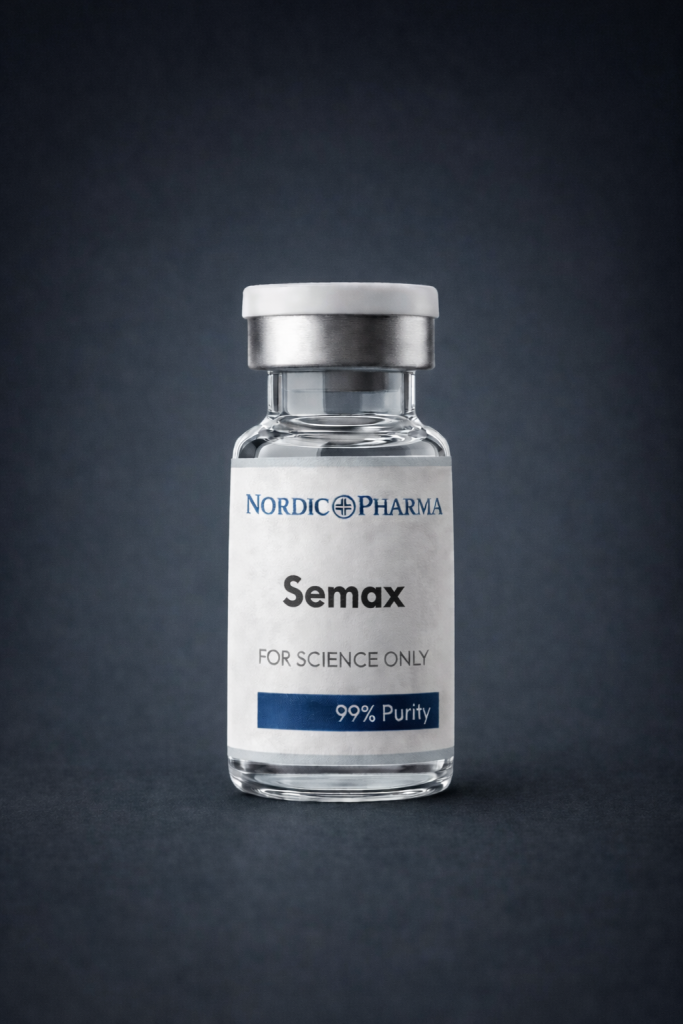
Semax | 10 vials
Semax is a synthetic heptapeptide (Met-Glu-His-Phe-Pro-Gly-Pro) developed in Russia as a nootropic and neuroprotective agent . It is an analog of the adrenocorticotropic hormone fragment ACTH(4-10), engineered with a C-terminal Pro-Gly-Pro sequence for enhanced metabolic stability and bioavailability via intranasal administration .
Key Specifications:
-
Synonyms: ACTH(4-7)-Pro-Gly-Pro, Met-Glu-His-Phe-Pro-Gly-Pro
-
Amino Acid Sequence: Met-Glu-His-Phe-Pro-Gly-Pro
-
Molecular Weight: ~821 Da
-
Purity: ≥98% (research grade)
-
Appearance: White lyophilized powder
-
Solubility: Soluble in water and physiological buffers
-
Bioavailability: High via intranasal route, with rapid brain penetration
-
Storage: Store at -20°C; protect from light and moisture
Mechanism of Action:
Semax exerts its effects through multiple complementary pathways:
| Target System | Effect |
|---|---|
| BDNF/trkB pathway | Upregulates BDNF expression (1.4-fold increase) and trkB phosphorylation (1.6-fold) in hippocampus, promoting neuronal survival and plasticity |
| Dopaminergic/Serotonergic systems | Activates these neurotransmitter systems, contributing to cognitive enhancement and mood regulation |
| NMDA receptors | Modulates NMDA receptor density depending on administration route and brain region |
| Copper chelation | Binds Cu(II) ions with high affinity, reducing ROS production and cytotoxicity associated with amyloid-β aggregation in Alzheimer's models |
| μ-opioid receptor targeting | Interacts with Oprm1 gene to promote deubiquitination and functional recovery after spinal cord injury |
| Intracellular calcium dynamics | Increases frequency of spontaneous calcium fluctuations in hippocampal pyramidal neurons |
Key Research Applications:
| Category | Applications |
|---|---|
| Cognitive Enhancement | Learning, memory consolidation, attention, working memory |
| Neuroprotection | Stroke (ischemic and hemorrhagic), traumatic brain injury, spinal cord injury |
| Neurodegenerative Disease | Alzheimer's disease (copper-mediated neurotoxicity), age-related cognitive decline |
| Neuroregeneration | Spinal cord injury recovery via USP18 regulation and deubiquitination pathways |
| Anxiety/Stress | Anxiolytic effects dependent on administration route and genetic background |
Clinical Status:
Semax is approved in Russia and select CIS states for the treatment of stroke (ischemic and hemorrhagic), traumatic brain injury, and cognitive disorders . It is NOT FDA approved for any medical use in the United States .
Important Notice:
FOR RESEARCH USE ONLY. NOT FOR HUMAN USE, THERAPEUTIC, OR DIAGNOSTIC APPLICATIONS.
Select Option & Quantity
Key Benefits
- High purity research compound (>98%)
- Third-party tested and verified
- Lyophilized for maximum stability
- Certificate of analysis available