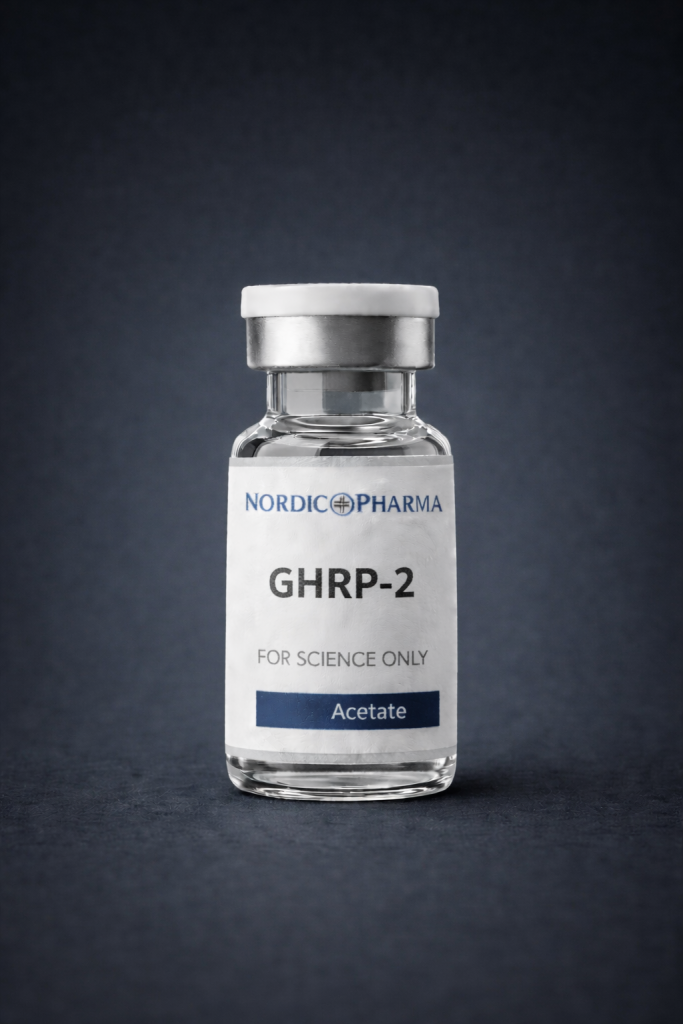
GHRP-2 Acetate | 10 vials
GHRP-2 (Growth Hormone-Releasing Peptide-2) , also known by its generic name Pralmorelin, is a synthetic hexapeptide that acts as a potent growth hormone secretagogue . It was developed as part of research into small peptides that stimulate growth hormone (GH) release and is an analogue of ghrelin, activating the growth hormone secretagogue receptor (GHS-R), also known as the ghrelin receptor .
Key Specifications:
-
CAS Number: 158861-67-7
-
Synonyms: Pralmorelin, KP-102, GPA 748, WAY-GPA-748
-
Molecular Formula: C₄₅H₅₅N₉O₆ (approx., based on structure)
-
Molecular Weight: Approximately 817.43 g/mol
-
Purity: ≥95-98% (research grade)
-
Appearance: Lyophilized powder
-
Storage: Store at -20°C; protect from light and moisture
Mechanism of Action:
GHRP-2 functions as a full agonist at the growth hormone secretagogue receptor 1 alpha (GHS-R1α) , the same receptor targeted by the natural hormone ghrelin . Key features include:
-
GHS-R1α activation: Binds to and activates the ghrelin receptor in the pituitary gland and hypothalamus
-
Synergistic GH release: Acts synergistically with growth hormone-releasing hormone (GHRH) to stimulate GH secretion
-
cAMP pathway involvement: Increases intracellular cAMP concentrations in somatotrophs, similar to GHRH in some species
-
Less sensitive to somatostatin: GH-releasing activity is less suppressed by endogenous somatostatin compared to GHRH
-
Hypothalamic action: Requires the median eminence (endogenous GHRH) to exert full GH-stimulating activity
Key Research Applications:
| Category | Applications |
|---|---|
| Growth Hormone Research | GH secretion studies, GHRH/GHRP synergy, somatotroph function |
| Tissue Repair | Tendon-bone healing (rotator cuff models), anti-inflammatory effects via M1 macrophage inhibition |
| Pain Research | Antinociceptive effects mediated through δ- and κ-opioid receptors |
| Diagnostic Use | GH deficiency testing (approved in Japan) |
Clinical Status:
Pralmorelin (GHRP-2) is approved in Japan (since 2004) as a diagnostic agent for hypothalamo-pituitary function and growth hormone deficiency . It has also been investigated for the treatment of short stature (pituitary dwarfism), with development reaching Phase II trials .
Important Notice:
FOR RESEARCH USE ONLY. NOT FOR HUMAN USE, THERAPEUTIC, OR DIAGNOSTIC APPLICATIONS outside approved clinical settings.
Select Option & Quantity
Key Benefits
- High purity research compound (>98%)
- Third-party tested and verified
- Lyophilized for maximum stability
- Certificate of analysis available